
The Cautionary Tale of Trump’s Threats to Free Speech: A Cornerstone of American Democracy

Edited by Emma Hartman, Juliette Calderon, Owen Andrews, and Sarah Ahmad
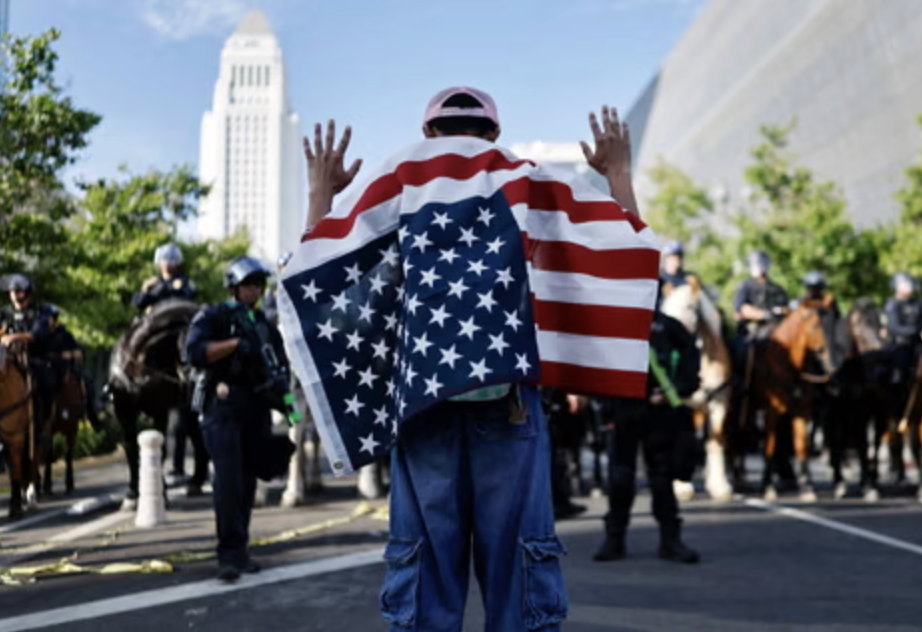
Since assuming power in January, the Trump administration has taken significant steps towards reshaping the American media and free speech in line with their vision. They do so by sidelining political opponents and institutions that disagree with Trump’s policies and detaining protestors nationwide. Within the short amount of time Trump has been president, he has made it a priority to crack down on free speech from students to the press. This restriction poses a threat to America’s core democratic principles and the First Amendment. It’s important to note these threats to free speech to ensure that First Amendment rights are not infringed upon and to remain conscious of the pseudo-authoritarian tactics that can be used to push political agendas. Attacks on the First Amendment should not go unnoticed as the Trump administration detains outspoken students, targets universities and their funding, and threatens or restricts certain news organizations.
The First Amendment protects freedom of religion, assembly, expression, and the right to petition. It also specifies that Congress is forbidden from restricting the press and citizens from speaking freely. The right to free speech is one of the most fundamental pillars in American politics—one that the Trump administration is actively chipping away at. Actions such as investigating news channels the administration disapproves of, such as ABC and NBC, and banning the Associated Press (AP) from attending certain press events, are all breaches of free speech. Trump has gone as far as to call journalists who report negatively on his administration “lawbreakers” and say that they should lose their licenses.
The key court case in 1803, Marbury v. Madison, established the principle of judicial review in American politics, which grants federal courts the ability to decide the constitutionality of legislation and executive actions. It has since become one of the defining features of checks and balances and the separation of powers in our political landscape. President Trump has challenged this key principle of judicial review by repeatedly sidelining federal judges in pursuit of his agenda. He ignored a decision by the chief judge of the US Court for Washington, D.C., that ordered the government to stop deportation flights holding immigrants from an alleged Venezuelan gang. Discarding the decisions made by federal judges is a clear threat to the independent responsibilities of the judicial branch and signals a lack of consequences for an overreach of power by the executive branch. Undermining judges’ decisions is both an infringement of the legal system and violation of the First Amendment that cannot be taken lightly.
In April of 2025, several international students at universities were detained by immigration agents for speaking up about the war in Gaza. A Turkish graduate student at Tufts University, Rumeysa Öztürk, was arrested by agents and is being targeted for an op-ed she wrote about Gaza. Mahmoud Khalil, a student at Columbia University and a legal US resident, was detained in his home for peacefully protesting Israel’s war in Gaza. U.S. Secretary of State Marco Rubio justified these arrests and the revoking of more than 300 student visas through a rarely used immigration law from 1952. It gives the Secretary of State the power to revoke legal immigration status if they are deemed to pose a threat to US foreign policy. These student arrests undermine the importance of citizenship, as students can still be arrested for being politically outspoken despite holding legal citizenship.
The Trump administration attacked American universities at the center of protests regarding the Israel-Gaza conflict, promoting affirmative action, and upholding diversity, equity, and inclusion (DEI) efforts; all the while the administration is promoting its Compact for Excellence in Higher Education initiative. Many prestigious institutions, such as Brown, Cornell, and Columbia, have paid millions to the administration to reinstate research funding and halt investigations into their universities. The White House also threatened to revoke federal funding from sixty universities unless they comply with federal civil rights laws and drop DEI initiatives. The University of Virginia is at the forefront of this issue, with the administration demanding the school’s president, Jim Ryan, resign to settle a DEI investigation by the Justice Department.
Similarly, President Trump has consistently pressured journalists and media organizations to align with his views. Trump celebrated ABC’s suspension of Jimmy Kimmel Live! after the host made comments about the assassination of Charlie Kirk, as well as CBS’s cancellation of The Late Show with Stephen Colbert days after criticizing Trump on air. Another example is the White House prohibiting the AP from attending press conferences because they refused to call the Gulf of Mexico the “Gulf of America.” The ban caused the AP to file a lawsuit against the administration, citing a violation of the due process clause and that journalists’ access to the White House is protected under the First Amendment. Trump has also pressured social media companies, forcing Meta to eliminate its fact-checking program following his threats.
While resisting the infringements on free speech can seem futile, here are some things policymakers can do to protect our rights. Existing laws and the role of the judiciary need to be reinforced to combat these infringements and preserve democracy. Policymakers should emphasize the role of the judiciary as an independent branch by displaying public respect for judicial decisions and providing enhanced security for judges in light of controversial cases. The Federal Communications Commission implemented the fairness doctrine, which required television and radio institutions to highlight diverse perspectives on controversial issues. Although it was later repealed in 1987, a policy similar to the fairness doctrine should be reinstated to ensure the media is not falling victim to threats from the administration while also addressing misinformation on social media platforms. Free speech is a defining aspect of the foundation of America, and growing attacks on citizens, institutions, and the media should be taken with caution. The media and protests alike serve as a form of expression for Americans, and circumventing rights embedded in the Constitution is unacceptable behavior for any president.