
How far Is PHAR enough?
https://commons.wikimedia.org/wiki/File:STOP_GENTRIFICATION_graffiti_in_Turin.jpg

Edited by Asmi Kansagra, Thomas Baxter, Owen Andrews, and Sarah Ahmad
Every fall, University of Virginia students find themselves searching for where to live next school year. There are really only two options: chancing it with non-guaranteed university-provided housing, or going “off-grounds” and finding a place to stay somewhere in Charlottesville. This search for “off-grounds” housing is difficult for students, but comes at even greater expense to those Charlottevillians who aren't Cavaliers. By entering Charlottesville’s housing market, UVA students bring more money to the table than the average Charlottesville citizen, which warps the market in their favor. For reference, as of 2017 (the latest year available), UVA students had a median family income of $155,500, as opposed to 2023’s $69,829 median for a Charlottesville resident. This extra money pumped into the housing market has a very simple side effect: a rise in pricing to levels unaffordable for local residents. This helps to explain why the average rent in Charlottesville has been rising at about 4% yearly, sitting at $1,950 for 2025.
If we compare this number to the Department of Housing and Urban Development (HUD)’s definition of affordable housing, we can start to see the problem. According to HUD, housing is unaffordable when it takes up more than 30% of an occupant’s income, and in the case of Charlottesville, the average monthly rent takes up about 34%. To give a more extreme example, 2020 research from the Charlottesville Low-Income Housing Coalition (CLIHC) shows that a minimum wage worker in the city would have to work 147 hours a week, or 21 hours a day, to afford even a competitive rent. It goes without saying that this is impossible. Consequently, either poorer residents being forced to move out as Charlottesville becomes too costly, or risk a life of homelessness in their own city. Put pointedly by Charlottesville Planning Commission Chair Solla-Yates in an email to CVille Tomorrow, Charlottesville’s low-income residents “are being displaced by people with significantly more resources.”
These additional resources also color what housing is built, furthering the inequality and accelerating the problem. In saying this, I mean that the inflation of prices by new, wealthier customers leads to the development of real estate being distorted. For example, instead of building low/livable-income housing for Charlottesville locals, there is an incentive to produce higher-priced, luxury housing in order to remain profitable. If you forget about our less than “economically viable” neighbors, this almost makes sense. Put simply, to meet the demands of the wealthier residents moving to Charlottesville, developers focus on building higher-priced housing with luxury amenities. This increasingly expensive housing then raises prices across the market to levels that those previously living in Charlottesville can’t afford. This is not to mention the general rise in all prices, as the cost of living rises to meet the wealthier transplant population. As this happens, those who can afford the cost of housing/living can stay in Charlottesville and enjoy its development, while poorer residents have no choice but to move out.
It would be a great disservice to not mention that this displacement of low-income Charlottesville is also occurring on racial lines. To make this clear, of the city’s families that make over $100,000, 88% are White, as opposed to only 9% Black. For reference, a person would need an annual income of $78,000 for housing in Charlottesville to be affordable. The continuous increase in rent makes this even more troubling, as if a 4% increase per year continues, it would take just 10 years for housing to become unaffordable even for a person making $100,000. This means that unless something changes, Charlottesville’s predominately White high-income earners will be the only ones who can afford to live in Charlottesville, while its predominately Black and Brown low-income earners will simply have to move aside and move out.
This pattern of economics leading to Black and Brown displacement is unfortunately a part of a much larger pattern in UVA and Charlottesville’s history. It can't be mentioned enough that the university was built by enslaved Africans, but even in more recent times, their descendants in Charlottesville have faced removal for financial reasons. An example can be found near Charlottesville’s downtown. Vinegar Hill, a predominately Black neighborhood and hub of commerce, was bulldozed by the city with supposed hopes of ”revitalizing” the local economy through “urban renewal.”
The destruction of Vinegar Hill in the 1960s was joined by the demolition of Gospel Hill in the 1970s. Gospel Hill was another Black neighborhood, this time bought up and destroyed for UVA’s Pinn Hall, Health Science Library, and other surrounding parts of its hospital system. While the attempt at urban renewal in Gospel Hill was unsuccessful, the same financial forces we’ve been discussing did the job instead. Black owners were offered prices they couldn't refuse by the university and sold their holdings. This came at the expense of those renters and workers who had no stake in Gospel Hill, except as members of the community. As our two examples show, financial factors have been a long-term cause of Black displacement in the city of Charlottesville, and today is no different. Be it by the government seizing land declared a “slum,” or by making moving the best financial option, the result is simple: money comes in, and Black/Brown people move out.
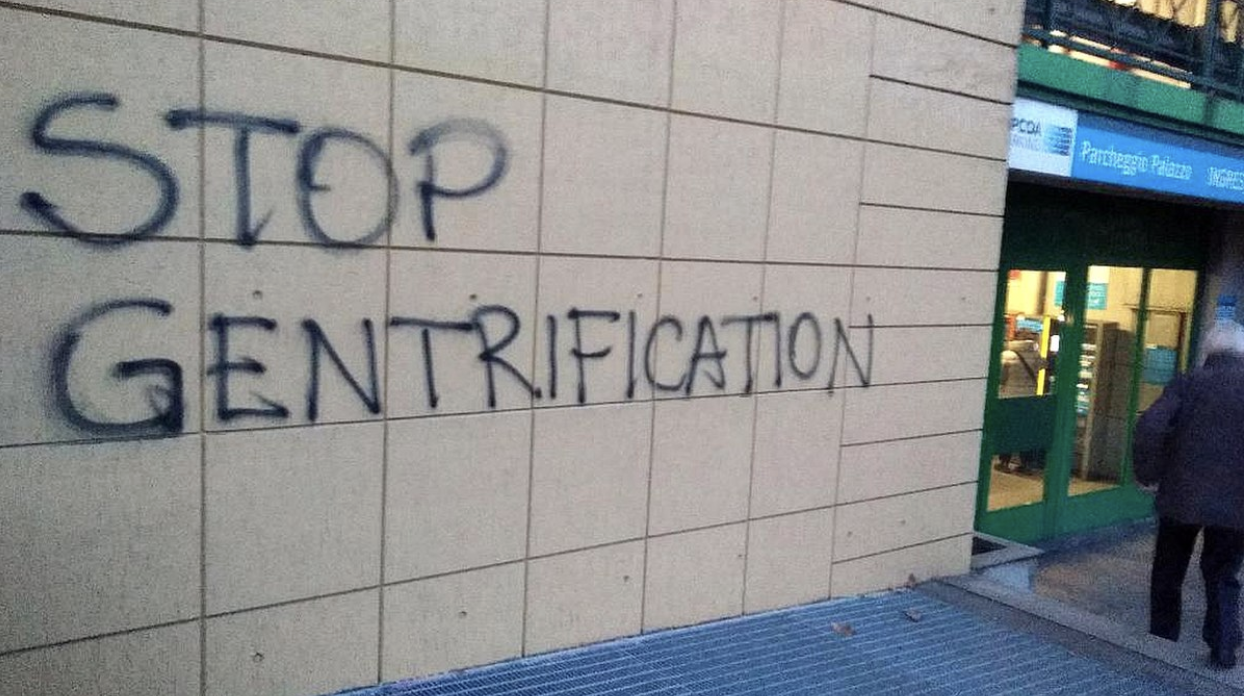
It should be noted that this situation is not just limited to Charlottesville. Across the United States, we can see Black and Brown communities priced out of their neighborhoods, making way for richer, predominately White transplants to move in. This process is called gentrification, and is occurring in virtually all major cities in the US, from LA and NY to even Washington, DC. Speaking of the nation's capital, “Chocolate City” has seen its Black population drop from 59% to 41% between 2000 and 2020, with the trend continuing to this day. Charlottesville has seen a less extreme drop, going from 22.2% Black to 15.1% over the same time period, but it stays part of this disturbing national trend.
Understanding this helps bring us to today, where all our issues come together. A new 11-story luxury complex on West Main Street is being proposed by Texan developer LV Collective, right next to Charlottesville’s predominately Black public housing community of Westhaven. This complex, if built, would go directly against the redevelopment plan created by Westhaven’s own in March 2025. The goal of this plan was to truly redevelop and expand the Westhaven community by adding 100 housing units as well as space for community events. Included in this plan would’ve been a connection between Westhaven and the rest of West Main Street, through a memory walkway recognizing the history of Vinegar Hill and Black Charlottesville as a whole. Developing this, we can see that financial interest, motivated by wealthy (predominantly white) Charlottesville’s demand for housing, yet again comes at the cost of the city’s Black population.
“And you know, sooner or later, it’s gon’ be an ACC town…”
- Joy Johnson, PHAR Co-Founder, after 10/6 City Council Meeting
Up until now, this article has not told the full story. From the beginning of this piece, we have tracked how economic incentives have, and continue to push out Charlottesville’s Black and Brown residents, but have failed to mention how they’ve pushed back. Painting Charlottesville’s locals as mere victims is to do them even further injustice. As such, here I introduce Charlottesville’s Public Housing Association of Residents (PHAR). Founded in 1998, PHAR was made by, and for, Charlottesville’s public housing residents. As the officially recognized representative of Charlottesville citizens in public housing, they voice the concerns of the people most affected by the housing crisis, and have fought and won victories like the Resident’s Bill of Rights for Redevelopment.
A main way of voicing these concerns has been to speak at city council, where local citizens, PHAR members, and Friends of PHAR all come together to speak about the human cost of development. More specifically, PHAR has been present at almost every city council meeting in the past few months to oppose the development by LV Collective. Rounding out this article, I attended the city council meeting on October 6th and was able to hear from PHAR in their own words. One of the speakers that night was Charlottesville native, PHAR co-founder, and nationally recognized activist Joy Johnson. In her remarks to city council, she laid out the problem of development perfectly, explaining how the construction of luxury apartments benefits no one but wealthy interests, as “even the [UVA] students are saying [they] can’t afford to live in these luxury ‘student’ apartments.” Mrs. Johnson also linked this development to the city’s history, mentioning how Westhaven was connected to Vingear Hill, and remains “the most political site in the city of Charlottesville.” As a solution, she concluded with a call to allow the people of Charlottesville more opportunities to voice their opposition to developments. To simplify her speech to just one quote, Charlottesville needs to "prioritize people over money.”
--
Later in the night, after speeches from other community members, I got a chance to briefly speak with Chair Johnson. As such, I wish to conclude this piece with an abridged and annotated version of the interview:
Ativoe: How would you situate it [the LV Collective development] in the greater history of Black Charlottesville?
Chair Johnson: The Black Charlottesville community is diminishing, it was 19% some years ago, and I’m really thinking it’s less than that. … Even though everything is going up, the pay for our residents who work at UVA has not gone up. So they’re paying higher rent, higher groceries, higher insurance, with the same money that they had.
Ativoe: I would just like to ask if you could put more of a point on how UVA plays a role. I did some reading on it, and they were talking about how UVA’s a big part of what’s bringing money in, but it’s not doing anything to give back to Charlottesville.
Chair Johnson: UVA’s bringing money in for themselves. They’re not bringing in no money [sic] for the city because they don’t even pay taxes. First part. And they’re not even trickling it down to their employees. It’s in endowment, it’s in developing, it’s doing all of this stuff. So, UVA is a cancer, it metastasizes in the community. I have a girlfriend who told me that this is the beginning of this community becoming an ACC community [in reference to the predominately white sporting conference UVA is a part of], and I didn’t understand it. I didn’t understand it. But I’m beginning to see it, right, because if you look at those luxury apartments, people rent those out, so that when they come to the football game, they come to the basketball game, they don’t have to stay in a hotel, they can rent those.
*City council attendees pass by and are greeted by Mrs. Johnson*
Chair Johnson: So, UVA is… Here’s what I would say to you. Thomas Jefferson was poor as hell when he died. Poor. He had to sell his slaves. …What is that saying to you? Somebody is still breathing that racist stuff, and you’re dead but you’re worth, how many billions? …So, there’s a whole lot of wrongs that UVA needs to make right, but they bully the city of Charlottesville. It’s like they own the city of Charlottesville. And you know, sooner or later, it’s gon’ be an ACC town… I don’t know. They’re the cancer. I don't know if it’s colon cancer, if it’s breast cancer, you know, I don’t know what kind of cancer it is, but it metastasized into all of our neighborhood that is in five square miles of UVA. And Westhaven is smack-dab, a stone throw from UVA.
--
In hearing Mrs. Johnson’s words, a few things jump out. Most pointedly, the idea of UVA as a “cancer” may seem harsh to readers. However, when listening to her, it is difficult to take offense at that diagnosis. What do you call an institution that takes over and drains resources from its surrounding areas before ultimately getting rid of them? UVA as an institution is what Mrs. Johnson is referring to, not just staff, attendees, or alumni. This is shown by her repeated concern for those who work at the university, as well as students, who she mentioned were also victims of UVA’s profit seeking. In viewing this, we can understand what she means. UVA, and the influx of money it brings to Charlottesville, exist directly on the basis of profit, with no regard to people of any variety. If it is currently profitable for wealthy students to enjoy luxury housing, then that’s what will happen. If the costs of housing are too steep for any students, then it’ll happen all the same. Even when it means that the Black and Brown workers who keep the university running will struggle to survive, profit is more important. It’s not difficult to understand calling the development of this kind of relationship the growth of a cancer.
However, in this relatively dark picture, we are actually presented with a beam of hope. If we join our fellow Charlottesville citizens in demanding their voices be heard, we in turn allow our voices to be heard. Luxury housing is just that, turning housing into a luxury, or better yet, turning a need into a want. By becoming a friend of PHAR, and helping them with their goals, we can bridge the artificial, racialized, and discriminatory division between “grounds” and “off-grounds”, coming together to be part of a true Charlottesville community. This community being one where everyone’s opinion is heard and acted on. If we don't, then we offer ourselves to the side of the developers, who as shown earlier, will have anyone moving out given it’s profitable.
Returning back to my interview with Mrs. Johnson, where she said, “UVA is a big piece of what needs to change.” This couldn’t be closer to the truth. UVA has immense, outsized influence on the government of Charlottesville and is directly a cause of the surge in the cost of living. Furthermore, many of the people who cook food, clean rooms, and fix faucets at the university are from the city. Even further, we all pay our tickets to the city of Charlottesville, go to the same Downtown Mall, and take the same CAT buses. Like it or not, UVA is inextricably related to Charlottesville.
With this in mind, anyone who claims an affiliation to UVA has to answer a simple question: what will this relationship be?
Addendum (Facts & Figures):
Charlottesville’s rent taking up ~34% of income: This was calculated by taking the average rent ($1,950), multiplying it by 12 for a year of payment ($1,950*12 = $23,400), then dividing it by the median income ($23,400/$69,829), for 33.5% of yearly income (0.335).
$78,000 being the threshold for Charlottesville’s rent to be affordable: Calculated using HUD’s 30% threshold, $23,400 for yearly rent requires $78,000 in yearly income in order to take up only 30% of the income.
Increasing unaffordability (rent becoming unaffordable at $100,000 income in ten years): Calculated by adding 3.8% to rent yearly for ten years ($741), for a total of $2,691. Then, I multiplied this future rent by 12 for a year of payment ($32,292), which would be ~32.2% of a yearly income of $100,000, or unaffordable.