
Women’s rights, wealth, and the limits of state feminism in Tunisia
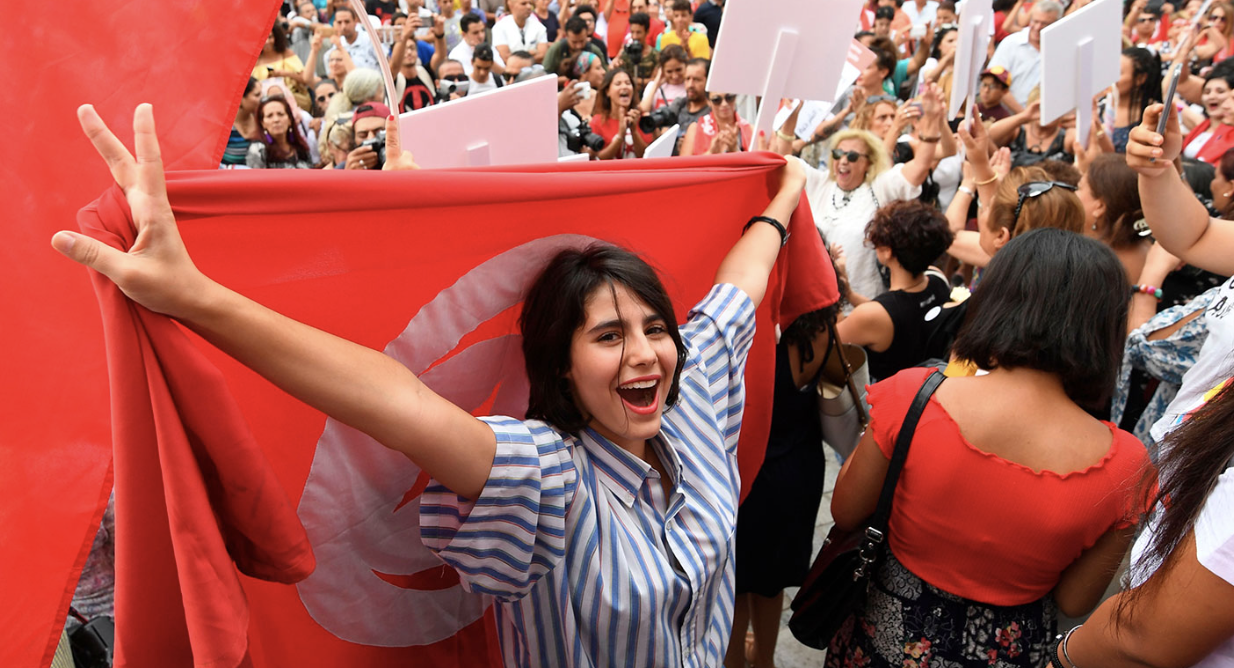
Tunisia is often described as a beacon of progressive gender reform in the Arab world and from the outside, its legal framework appears to place women at the center of national modernity. Yet beneath this reputation lies a more complicated reality: women’s rights in Tunisia have frequently been deployed as a political tool by authoritarian regimes, rather than secured through sustained structural change. The struggle over women’s equal inheritance rights reveals the limits of state feminism and underscores why autonomous feminist organizing, rather than representation alone, remains the most effective path forward.
Since the end of French colonialism, Tunisia has been marked by supposed secularism, Western liberal values, and a commitment to women’s rights. At the same time, international organizations have consistently identified Tunisia’s political leadership as authoritarian. From its founding, the independent Tunisian state concentrated power in the hands of the president, beginning with Habib Bourguiba. Bourguiba introduced significant social reforms, most notably the 1956 Code of Personal Status, which granted women rights in divorce, outlawed polygamy, instituted a minimum age for marriage, and reshaped family law. Yet these reforms did not emerge from grassroots feminist mobilization. Bourguiba himself admitted that there was no feminist movement demanding the abolition of polygamy or the promulgation of the Code of Personal Status. Women’s rights were introduced as part of a broader modernization project designed to legitimize the state, rather than as a response to women’s political demands. This top-down approach—often described as “state feminism”—embedded women’s rights within authoritarian governance.
The creation of the National Union of Tunisian Women (UNFT) in 1956 further illustrates this dynamic. By merging existing feminist organizations into a single state-aligned entity, the regime ensured that women’s organizing remained dependent on established political power. The UNFT operated less as an advocate for women and more as an extension of the ruling party. Its leadership openly acknowledged its reliance on presidential and party support, seen in Radhia Haddad, the first president of the UNFT’s statement, “Our strength is first in the President’s support…the Party and men’s support as a whole. We would have been powerless without their understanding.” As scholars have noted, the UNFT’s purpose was not to empower women independently but to keep them politically assisted and contained.
This version of feminism came at a cost: while women gained formal legal rights, the state defined the terms of their liberation. Policies such as Circular 108, which banned the hijab, revealed a disconnect between women’s lived realities and the state’s understanding of emancipation. Rather than expanding women’s freedom, state feminism often substituted one form of control for another. Under successive regimes, including that of Zine El Abidine Ben Ali and now President Kais Saied, women’s rights rhetoric has been used to mask authoritarian consolidation. Ben Ali continued Bourguiba’s feminist discourse while overseeing some of the harshest crackdowns against women, particularly those who refused to conform to state-defined norms. Thousands of women testified before Tunisia’s Truth and Dignity Commission about abuse, torture, and repression, even as women occupied parliamentary seats under gender quotas.
President Saied has continued this pattern. While opposing equal inheritance rights outright, his administration has engaged in what many activists describe as “pinkwashing”—deploying women’s representation to obscure authoritarian practices. The appointment of Najla Bouden as Tunisia’s first female prime minister was widely celebrated internationally, yet feminist activists criticized her tenure as lacking any substantive commitment to women’s rights or equality. Representation without power has done little to alter women’s material conditions.
The fight for equal inheritance rights sits at the core of women’s liberation in Tunisia because it is fundamentally about wealth, citizenship, and power. Inheritance law remains based on Islamic Shari’a principles, which generally grant sons twice the share of daughters. This legal structure reinforces patriarchal authority by controlling women’s access to land and economic independence. Although women constitute a significant portion of the agricultural labor force, they own less than five percent of land in Tunisia. In rural areas, women often work under dangerous conditions, receive half the wages of men, and are denied control over their allotted shares of land, which are frequently managed by male relatives. Land ownership in Tunisia is closely tied to citizenship, honor, and social status. Excluding women from land ownership effectively excludes them from full citizenship.
The economic consequences of unequal inheritance extend into every aspect of women’s lives. Financial dependence increases vulnerability to domestic violence, social marginalization, and systemic misogyny. Despite legislation such as Law 58, which aimed to combat violence against women, domestic violence remains pervasive. Reports to national hotlines reveal that the majority of violence against women is committed by domestic partners, underscoring the limits of legal reform without economic justice.
State feminism has failed to address these structural issues. Policies that claim to protect women without altering wealth distribution or social power leave women in a state of conditional citizenship. Inheritance equality is not simply a legal issue; it is a question of whether women are recognized as full economic and political subjects.
For years, Tunisia led the Arab world in women’s legislative representation. Women played key roles in shaping the 2014 constitution following the Arab Spring, including ensuring that gender equality was explicitly protected. The intervention of Selma Hédia Mabrouk, who exposed language in the draft constitution that framed women as “complements” to men, demonstrated the impact women legislators could have under favorable political conditions.
Yet these gains proved fragile. As authoritarianism reasserted itself, women in political office faced intense harassment, misogynistic attacks, and institutional constraints. Gendered disinformation campaigns targeted women judges, lawmakers, and activists, weaponizing sexuality and morality to delegitimize women’s authority. Physical violence in parliament, online abuse, and public shaming have become common tools used to push women out of public life.
More fundamentally, women politicians operating within authoritarian systems are limited by the very structures they seek to reform. As political theorists have argued, descriptive representation does not guarantee substantive representation. Sharing an identity with a marginalized group does not ensure that its interests are advanced, especially when political survival depends on loyalty to authoritarian leadership.
In contrast, autonomous women’s organizations have demonstrated a far greater capacity to challenge both patriarchy and authoritarianism. The Tunisian Association of Democratic Women (ATFD) has been central to the fight for equal inheritance rights, employing a multifaceted strategy that includes public demonstrations, media campaigns, research, and policy advocacy.
ATFD has organized mass marches demanding inheritance equality, framed the issue as a matter of rights rather than privilege, and engaged in sustained public education campaigns. Through its research arm, AFTURD, the organization has produced data documenting the material impact of discriminatory inheritance laws, strengthening the case for reform. This research has informed legislative efforts and supported women policymakers, illustrating the symbiotic relationship between activists and legislators. Crucially, ATFD has maintained independence from the state. Unlike women politicians who risk dismissal or repression, autonomous organizations possess collective protection and international networks of support. This independence has allowed ATFD to challenge authoritarian regimes directly, from opposing Ben Ali in the 1990s to criticizing Saied’s consolidation of power today.
ATFD has also been vocal in exposing the regime’s use of women as political instruments. By calling out the involvement of Saied’s wife in promoting the new constitution, the organization highlighted how women’s visibility can be manipulated to legitimize anti-democratic policies. Autonomous feminist organizing does not merely seek inclusion within existing systems but rather questions the systems themselves.
Tunisia’s experience exposes the limits of feminism deployed from above. While state-led reforms have produced symbolic gains, they have repeatedly failed to dismantle the economic and political structures that sustain women’s subordination. Equal inheritance rights remain out of reach not because women lack representation, but because authoritarian governance resists any redistribution of power. The path forward requires centering autonomous feminist organizing as both a women’s rights strategy and a democratic project. Challenging unequal inheritance laws means challenging the political order that upholds them.
As Tunisia continues to grapple with authoritarian consolidation, the future of women’s liberation will depend on movements willing to confront the state, redefine citizenship, and insist that gender equality is not a performance but a redistribution of power.