
Polarization in the United States: An Interview with Professor Rachel Wahl
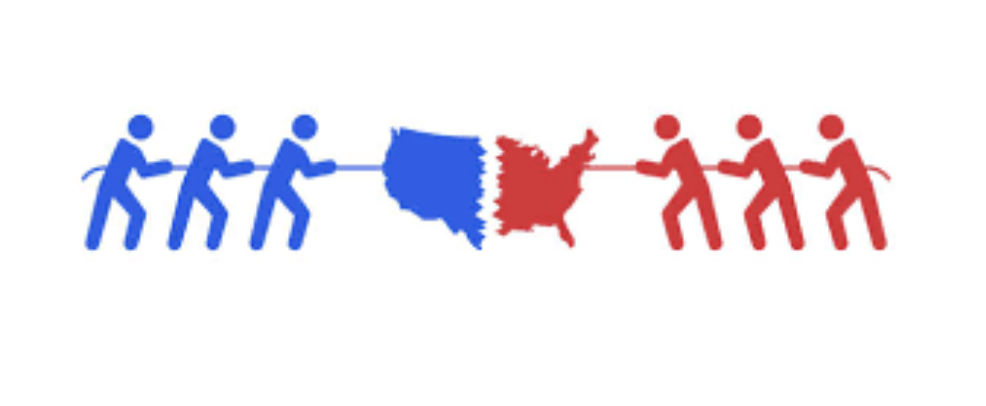
I recently had the privilege of speaking with Professor Rachel Wahl of the School of Education and Human Development. As the director of the Good Life Political Project at the Karsh Institute of Democracy, Dr. Wahl draws on her extensive background in human development to understand how various factors influence a person’s receptiveness to information. Professor Wahl’s research also inspired the creation of the Civic Cornerstone Fellowship (within the Karsh Institute of Democracy), which aims to teach students how to disagree more effectively and develop the skills to have open, respectful conversations about politics. Her background provides her an insightful perspective on the impact of political polarization in the United States and on future actions to remedy it.
The following transcript has been edited for clarity:
Crosby: How do you define political polarization?
Dr. Wahl: Usually, it's talked about in terms of the measures of effective polarization versus issue polarization; there are some other ways to categorize it, but I think those are the broadest two ways to think about it. Effective polarization is how people feel about people on the other side, whereas issue-based polarization is how people view political issues. What’s not captured in that is what I think drives much of the current polarization: inclusion or alienation from mainstream institutions.
And therefore, the extent to which, or whether one trusts mainstream institutions, particularly universities, scientific and medical authorities, and so forth. And so I don't think that's quite as well captured in this issue-based versus effective, but I think it's so helpful to have those ways to think about it.
Crosby: How have we seen changes in the amount of these two kinds of polarization in recent years?
Dr. Wahl: I think it's become relatively well documented that effective colorization has increased, but the extent to which people personally identify with their partisan group against the other partisan group seems to have also increased.
Perhaps due to, and in part reflective of, the ideological sorting of the parties, so that which political party you're in has more to say now about your ideology than it did in past decades, because the parties have sorted ideologically. So, it seems pretty well documented, and at least effective polarization has increased.
Crosby: In terms of parties representing ideologies a lot more in recent years, do you think there's a leading force driving that change?
Dr. Wahl: I think there are many different sources, and there are many competing explanations for it. I would be surprised if any one explanation were correct on its own. It may be a combination of growing economic disparity that gives more people reason to feel alienated from parts of the country.
It could be simultaneously related to differences between urban and rural ways of life and to the geographic ideological sorting that may accompany them. Historians trace this sorting to the realignment of the political party during the civil rights movement. It's hard to know precisely what historically is responsible.
Crosby: Going into what has been historically responsible, do you think that specific events, including the death of Charlie Kirk and the government shutdown, are symptoms of polarization or what is causing and driving it?
Dr. Wahl: I would say more symptoms than what is causing and driving it, because I think any event in itself could generate myriad responses among the national unity. But it's hard to imagine an event that would generate national unity at this moment.
Crosby: For attempting to have that national unity, how have political institutions contributed to or been affected by this polarization?
Dr. Wahl: It seems clear that political parties and elected officials are stoking polarization for electoral advantage, and that bipartisan collaboration is not viewed as an effective strategy for garnering votes. And the parties seem to be trying to mobilize their bases by stoking partisan animosity.
Crosby: Do you think there has always been polarization, and that it has just gotten worse in recent years, or did we not use to function this way, and can we go back to that state?
Dr. Wahl: Well, I don't know. It would be interesting to talk to a historian who specializes in political advertising, political campaigns, or related studies. I think there have been various moments in our history that have been more or less patriotic. I believe there was a time when we consciously sought to create more ideologically identifiable parties. Ezra Klein's book, Why We're Polarized, talks about this. Including the way that the American Political Science Association said in the 1950s, "Nobody can tell the difference between the parties, and it's making it hard for voters to make a choice." So we needed clearer ideological markers to show how the parties differ. So there was an intentional desire to differentiate. But it's hard to say exactly what the rhetoric was like at different points.
Crosby: What do you view as the most significant risk polarization poses to how we function as a democracy?
Dr. Wahl: I think the most significant risk is that when these incentives for political parties are to show that they oppose the other side more than that they can solve public problems, then the situation of many people will get worse. Further deepening anger and alienation, which could lead to violence and particularly the scrapping of vulnerable groups, as people search around for sources of their problems.
Crosby: With this being the most significant risk of the current polarization, do you see any strategies that our legislators or the average American can take to help bridge those divides?
Dr. Wahl: Well, it's difficult to dictate to Congress directly. However, I think, at the level of the average American, if more people preferred politicians willing to solve problems cooperatively and productively, that might, over time, influence the composition of bodies like Congress.
Crosby: How can universities help rebuild a shared democratic culture?
Dr. Wahl: Well, I think there are many different ways. UVA houses programs that I've been involved in developing, including the Civic Cornerstone Fellowship. We have 400 students who meet every month to have structured conversations and engage in ideologically diverse groups about politics, with the goal of helping students understand what is really at the root of their disagreements. So, I think that kind of program can help. I also think faculty modeling, the combination of civic commitment and open inquiry across different ideas, is helpful. And I believe in striving to create a university community that is more accessible, with a broader range of people, so that there is less resentment toward institutions perceived as elite and inaccessible.
Crosby: Overall, given these risks and what average Americans and universities can do to address polarization, are you optimistic or pessimistic about the future of polarization and how it affects our democracy?
Dr. Wahl: I think I'm always both simultaneously. But I try to be optimistic; it depends on the time of day. Hope for the best, prepare for the worst, right?