
An interview with Ann Oliva
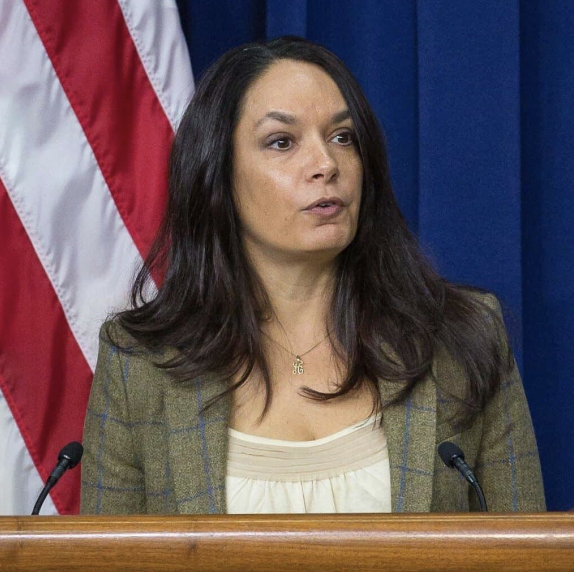
Ann Oliva Background
Ann Oliva is the President and CEO of the National Alliance to End Homelessness (NAEH). Before joining the Alliance, she was a Senior Policy Advisor at the Center on Budget and Policy Priorities, focusing on federal housing programs and their connection to health and human services. From 2007 to 2017, she served in senior leadership roles at the U.S. Department of Housing and Urban Development (HUD), including Deputy Assistant Secretary for Special Needs. In that role, she led the Office of Special Needs Assistance Programs (SNAPS), which manages federal homelessness assistance funding through programs such as the Continuum of Care and Emergency Solutions Grants.
Ria: To start us off, can you tell us a little bit about yourself and your journey into this work?
Ann: I come from a family of immigrants. I’m first-generation American–my parents came from Cuba. I was born here, but my older brother was not, and my sister was. My mom was actually pregnant with my sister when my family came to the U.S.
I like to say that the experience of being an immigrant family–needing some help when we first arrived, when my parents were just trying to get themselves established–really shaped us. It resulted in me and my siblings all becoming “do-gooders” in some way, shape, or form.
I think my orientation has always been toward service in some way. Right after I graduated from college, I served a year as a VISTA volunteer, and that experience helped me find my path toward homelessness as the issue I wanted to spend my professional time working on.
Ria: When you were at HUD, you oversaw major funding streams like the Continuum of Care program. What did you take away from that experience about how federal policies actually worked once they hit the ground?
Ann: So I went into the federal government with no previous government experience, which is a little bit unusual, especially for a career person. Just to be clear, I was not a political appointee–I was a career civil servant, and I went in as an office director. A lot of people usually come up through the government system rather than coming in from the outside.
I always found that outside perspective to be really valuable to my service. I say that because, at least for the first several years, it was easy for me to understand how a decision that I was making–or that the department was making–was going to play out in real life, on the ground in programs and in communities.
Then, at about ten years in–my ten-year mark–it started to feel like I was losing that thread a little bit, and I wanted to go back into the community.
I learned so much during my federal service. I learned about the power of relationships and the importance of having really strong relationships not just with my own staff, but with leaders all over the federal government. I also learned about the power of debate and the importance of making sure I had people around me with differing points of view–I think that made me a better leader.
I would say that I learned more during that period than in any other single period of my career. I learned about leadership–what it means to be a leader in really hard times, what it means to be a leader when things are going your way, and how to lead a team with integrity and a strong mission orientation.
Ria: As CEO of the Alliance, how do you navigate the balance between shaping national policy and staying close to the everyday realities and challenges local communities face?
Ann: If you look at the 30-something years of my career, you’ll see that I’ve moved from local work to national or federal work, and then back to local work, and back to national or federal work. I’ve done that intentionally for the reasons I just talked about because I need to understand what happens on the ground when I make a decision at the national level. And the only way to really do that is to put yourself in a situation where you have access to both the national and the local levels.
I think the beauty of this place, of the National Alliance to End Homelessness and my position here, is that I’m not one or the other. We’re not just one or the other. We do a lot of work at the federal level, but we also have, through our conferences and through my travels–I do a lot of speaking engagements–all of those things allow me to keep my finger on the pulse of both sides of that spectrum. And that, hopefully, helps me not just navigate my own work, but also advise other leaders on how to navigate theirs.
Ria: The Alliance has emphasized the importance of racial equity. From what you’ve seen, where are communities meaningfully putting equity into practice, and where does it risk becoming more symbolic than real?
Ann: It’s a really hard question right at this moment, honestly. If you’d asked me that question even a year or a year and a half ago, I might have answered it really differently. What I can say is that communities who, as part of their equity work, meaningfully partner with people who have experienced homelessness–I feel like those are some of the communities making the best progress right now. That’s in part because of how overrepresented marginalized people are in the homeless population, but also because people who have actually gone through the homeless services system have a unique and really powerful set of expertise and knowledge about what needs to be fixed and how to fix it, or what needs to be kept and how to lean more heavily on those practices.
Right now, I think people are really scared because of the political environment around using the word “equity” or “DEI,” or anything in that realm–what folks are being attacked for. But plenty of communities are still doing the work, even if they don’t use the same language. I would also say that the ones doing the best work right now are really leaning on the leadership of their partners with lived expertise.
I find that almost inspirational. It’s like folks are saying, “Okay, we’re going to figure this out one way or another, and we’re going to continue doing the work we know has an impact.” One of the ways to do that is to ensure–and I don’t mean tokenized efforts–I mean making sure there are real pathways for people into leadership positions. Talking about leadership with partners who have lived expertise. Hiring people with lived expertise into key positions, or onto boards that actually have power.
All that to say, I think it’s a hard question to answer right now because folks are still trying to do good work without using the language that’s going to get them targeted
Ria: Looking ahead, what policy practices give you the most confidence that we can actually implement on homelessness in the next decade?
Ann: The way to end homelessness is to have enough affordable housing in this country. I think that the housing sector–the affordable housing sector–and the homelessness sector, for a really long time, operated in silos for most of my career. Those two areas functioned pretty separately.
i think one of the policy areas that’s going to change as a result of all of this, going back to the fact that this is an affordable housing crisis, is that we had a pandemic that created conditions we just were not prepared for in terms of affordability. And in homelessness, we saw a skyrocketing number of people becoming unstable.
I think that the coming together of the housing world, the affordable housing world, and the homelessness world to pursue things like maybe social housing, or universal vouchers–which would mean that anybody who is eligible for rental assistance could get it, in the same way that we have universal education–I think that’s really important. I also think that prevention is something we’re going to lean a little harder on as well, because we cannot sustain this level of inflow into the system. Prevention, just by definition, has to include other systems of care that are not just the homelessness system.
I hope that what we see over the next 10 years isn’t just defense, which is where we are right now. We’re really on defense, like with a lot of social issues where it feels like we’re constantly reacting. I do think there is a path that helps us integrate with other movements and systems in a way that actually makes sense for people who are either at risk of homelessness or already experiencing homelessness.
Ria: Finally, for students and young professionals entering policy work, do you have any advice?
Ann: The advice I tend to give everybody is to be yourself, understand what your values are, and work in alignment with those values, even when it’s hard. The other thing is, I think that at least for me, what I’ve seen, especially in D.C.--because that’s where I’ve been for a long time–people can get really caught up in the idea of, “I want to move up. I want to advance.” And that’s not bad. That’s not a bad thing at all.
What I’m trying to differentiate is that, for example, it could have been seen as a demotion for me to go from being a deputy assistant secretary to working in the community. But that’s not how I saw it. I tried to be–and I hope that others, especially young people who might be reading your work, can see this too–that sometimes your trajectory isn’t just a straight line up to more money and a different position.
I think that if you’re mission-oriented and you have clear goals around the kind of policy you want to work toward, sometimes you need to make decisions about how you get the skills and expertise you need to make good policy at whatever level you’re aiming for–whether that’s the state level, the local level, or the federal or national level. And sometimes I see people get caught up in the policy career rather than the policy goal.
I know for me, it has always served me in the long run to go back to my roots and say, “Okay, I’m going to spend a couple of years here at the local level, figuring out what works and what doesn’t, and hearing from people who are doing this on the ground.” And then I go back up to the national level and bring that education along with me.
That’s my advice: be yourself, know what your values are, and don’t be afraid to figure out how to learn the skills and the expertise you need, even if it’s not a straight line.