
Cigarettes and social media: The problem with warning labels
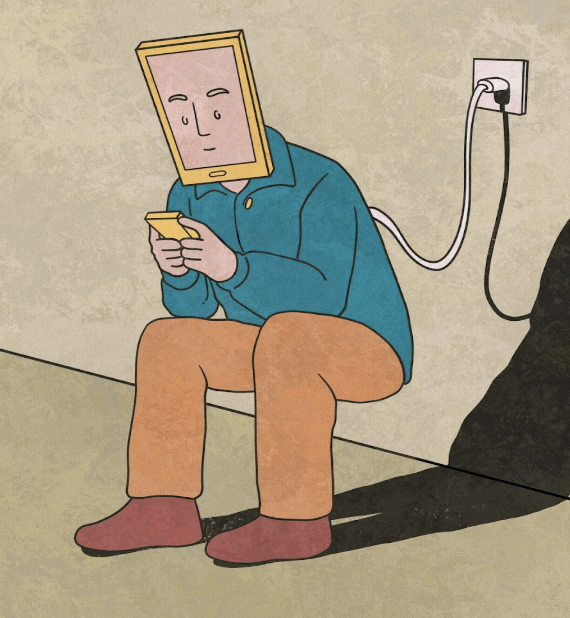
https://pixabay.com/illustrations/creativity-thinking-painting-4912415/
Edited by Alex Elstrodt, Astrid Cheng, Amelia Cantwell, and Owen Andrews
In recent months, policymakers have turned to warning labels as a proposed solution to problems arising from increased social media usage. At the end of 2025, California Governor Gavin Newsom signed a law that requires social media companies to display labels warning users about the mental health effects of certain features. This shift is part of a nationwide movement, highlighted by the former Surgeon General Vivek Murthy's urgent call to raise awareness about social media addiction and its impact on adolescent mental health. Policymakers are particularly concerned about teenagers, one of the most vulnerable groups of social media users. This growing concern reflects the exponential growth in media, with a recent study showing that roughly 60% of teenagers regularly use social media platforms like TikTok and Instagram. California isn’t the only state spearheading this battle against addiction: New York Governor Kathy Hochul signed a similar bill in December, reiterating the importance of protecting the mental health of younger users.
Warning labels have become a popular, low-cost way for policymakers to address addictive behaviors.This confidence in warning labels is not entirely unfounded: Labels for cigarettes and vapes have been spectacularly effective—policy evaluations have found that big, bold labels reduced the consumption of cigarettes, vapes, and other nicotine-based products by 26%. Encouraged by this success, prominent policymakers have decided to adopt warning labels on social media. But what works for cigarettes and food products may not meaningfully change behavior on social media, where the mechanism of addiction plays a key role.
Although it may be tempting to treat cigarettes as analogous to social media, familiar tools may not be equipped to deal with this new age of addiction and its consequences for mental health. Although mental health concerns have highlighted the need for new regulations, legislation forcing TikTok to use labels may only have a limited impact on mitigating the harmful consequences of social media.
Beyond obvious physical differences, the nature of addiction significantly impacts the way in which we need to deal with these issues. Internet addiction is a newly emerging behavioral form of addiction, while nicotine use is a classic case study of chemical addiction.
Although both nicotine and social media operate by flooding the brain’s dopamine receptors, the key difference lies in the mechanism of addiction. Nicotine works by overstimulating the brain’s reward system, causing dopamine release and slowly creating physical dependence. With social media, the algorithm creates the addiction. It creates an infinite dopamine loop through features like personalized content and autoplay, specifically designed to hook the brain’s reward center and encourage infamous cycles of doom-scrolling. When the addiction mechanism is embedded within each layer of the platform’s design, warning labels aimed at consumer awareness may struggle to have the same effect as those on nicotine products.
Empirical evidence supporting warning labels on social media is also far less convincing as compared to cigarettes. We all know that nicotine is harmful. Decades of research have allowed us to reach this scientifically supported conclusion. However, social media addiction continues to be a debated subject area. Although many find themselves in a destructive cycle of comparison and insecurity, plenty of other users engage with social media in healthier ways. Preliminary studies have found a far more complex association between digital technology use and adolescent well-being, than the common assumption of social media simply being bad. Research evaluating social media’s impact on mental health is still in the process of establishing concrete causes and risks. Warning labels work best when used on products with a broad user base and clearly identified risks. There is no doubt that links exist between social media, addiction, and adolescent mental health. However, we need more research to determine the extent and nature of their relationship to determine whether warning labels are the best approach.
Social media addiction cannot be explained by physical phenomena alone; as such, this 21st-century problem cannot be solved by simply defaulting to a 20th-century reflex. It requires more creative solutions, such as policies that directly address the source of addiction through redesigning and curbing excessive algorithm development. Projects like Breaking the Algorithm, which aim to create healthier spaces for adolescents online by advocating for stronger algorithmic regulation, illustrate how redesigning engagement-driven systems can target the mechanism fueling social media addiction.
Warning labels have a well-deserved reputation in the healthcare policy space. However, social media presents a fundamentally different challenge. When an entire sphere of technology revolves around the principle of addiction, awareness isn’t enough to create real change. Over-reliance on warning labels can have a detrimental impact on the potential of social media reforms by limiting the scope of future discourse and legislation. Trying to use the same solution to solve an entirely different equation is unlikely to yield effective results. Rather, structured reforms and deeper research can contribute to making social media a healthier space for adolescents.