
The redistricting fight consuming United States politics
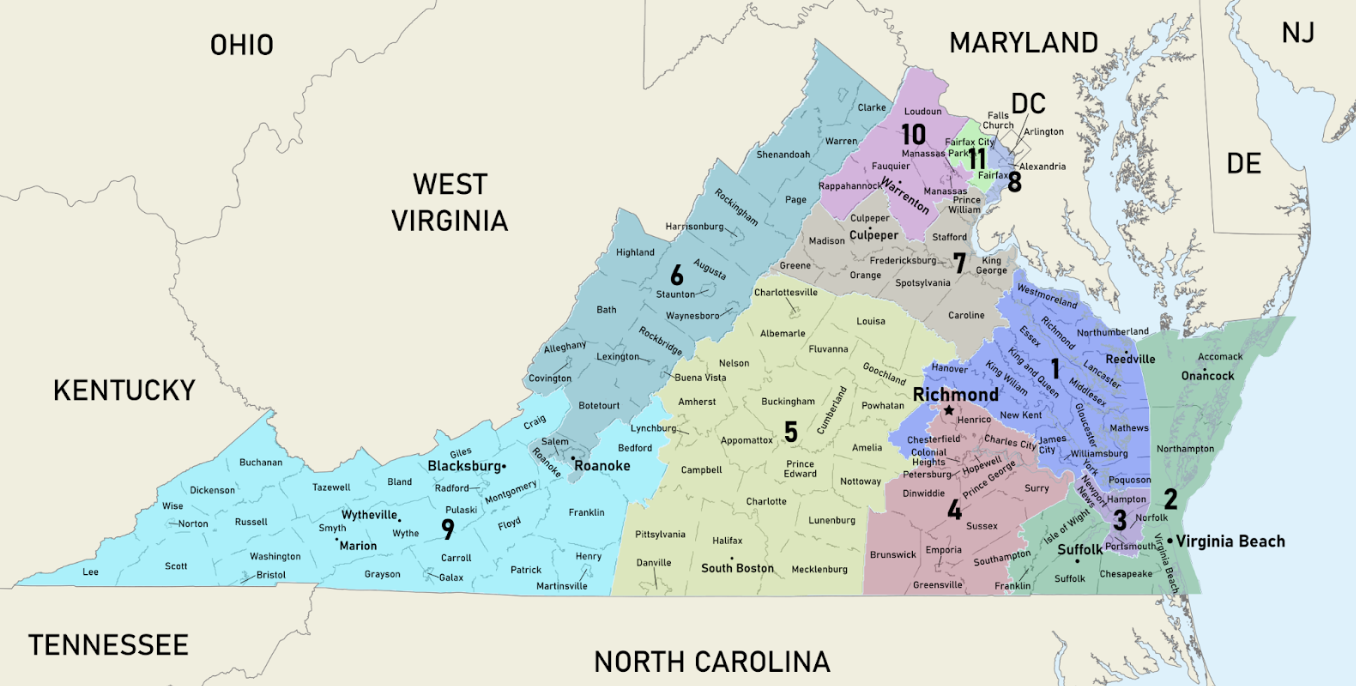
https://commons.wikimedia.org/wiki/File:Virginia_Congressional_Districts,_118th_Congress.png

Edited by Arya Kumar, Rishi Chandra, Amelia Cantwell, and Owen Andrews
Redistricting is the process of redrawing congressional maps to reflect population shifts; the 2026 fight over redistricting of the U.S. Congressional districts began in Texas when Governor Greg Abbott requested that the state legislature consider redrawing the state’s districts in favor of Republicans, a practice known as gerrymandering. In response, the Democratic governor of California, Gavin Newsom, launched his own redistricting effort, including a special election to legitimize his new congressional map. This back-and-forth has set off a nationwide political firestorm. Spreading state to state, the partisan redistricting efforts have made their way to Virginia, and legal efforts to block the Democratic redistricting effort in Virginia have reached the state’s Supreme Court. A case filed by Judge Jack Hurley in Tazewell County is attempting to block the special election aimed at revising Virginia’s constitutional redistricting process. While the court is still examining the legality of the maps, the April special election has been allowed to proceed. This would create an opportunity for the Democratic state legislature and executive to redistrict the state before the 2026 midterm elections. This effort could allow partisan gerrymandering and establish a precedent that future leaders could exploit.
The idea of mid-decade redistricting brings about many legal questions, even without considering partisan issues. The Constitution states in Article One, Section Two, “Representatives…shall be apportioned…according to their numbers, which shall be determined by adding the whole number of persons.” It continues to say, “The actual enumeration shall be made… within every subsequent ten-year term.” While this section outlines the census process, it states that representation should strictly align “to their numbers.” Although the constitution does not explicitly prohibit mid-decade redistricting, it ties representation to population data. If redistricting is to occur in a state, a census should take place to accurately redraw the bounds of congressional districts. The principle of popular sovereignty, which is included in founding documents such as the Declaration of Independence, would be shunned if redistricting efforts were to be conducted without a clear number of individuals who live in the state. The principle exudes the idea that everyone's voice should be heard and accounted for to have laws, taxes, or other governmental functions placed upon citizens. With the creation of these partisan districts, the people have been silenced by the government and therefore do not have the adequate representation that the founding fathers established this nation on.
The mid-decade effort does not align with the collection of census data; therefore, the maps could disenfranchise areas due to population shifts that may have occurred in the five years since the last census. While redistricting is not a federal power, the Constitution does provide guidelines for the collection of data used to construct districts in Article 1, Section 2, Clause 3. The Constitution allows the states to decide how they draw these boundaries. Virginia’s voters passed the constitutional amendment that created this process in the 2020 election. This amendment created a commission that was composed of sixteen individuals, eight legislators and eight citizens, intending to create a fairer process of redistricting in Virginia.
The Virginia redistricting commission produced a map that received an “A” grade from the Princeton Gerrymandering Project. According to the project, which assesses how partisan and competitive each district is, Virginia’s congressional map is one of the fairest in the nation. However, this proposed amendment to the 2026 special election repeals the commission and returns the process to the state legislature, and the proposed map consolidates power concretely with the commonwealth's Democratic Party. The current map has a power share of 4 Republican and 7 Democratic seats, which roughly translates to the 60-40 split in statewide elections between the Democratic and Republican Parties. This congressional map reflects the state's overall consensus on political issues effectively. The new map consolidates these 4 Republican seats, which include cities such as Roanoke, Charlottesville, Virginia Beach, and Williamsburg, into a single seat covering the southwestern portion of the Commonwealth.
Many critics have taken legal action regarding these partisan redistricting efforts. Tazewell County’s Circuit Court issued a verdict that moves to invalidate the April special election amendment on mid-decade redistricting. The court reasoned that the verdict rested on the argument that the legislature did not follow the state’s redistricting procedures. The court cited misleading language in the proposed redistricting amendment that is the focal point of the April special election. The case is currently being appealed to the State Supreme Court but will not be litigated until after the special election. While Virginia is currently at the forefront of this issue, the outcomes of this case could have nationwide implications. The issues with mid-decade redistricting, specifically the partisan tactics of gerrymandering, set a dangerous precedent for future leaders to weaponize if not put in check.
While the passage of this amendment would make the process constitutional at the state level, the federal Constitution could be violated by failing to use up-to-date population data in redistricting efforts. As stated in Art. 1.S2.C3, representatives should be apportioned based on the census every ten years. The constitution does not outline if or when redistricting should occur within the ten years. Without the Constitution legitimizing the process of mid-decade redistricting, there is potential to strike this process down as unconstitutional. However, this might not be the current Supreme Court's view of this article’s powers. Still, the effects of this mid-decade redistricting fight could have lasting impacts on the entire nation. This mid-decade process seeks to create partisan advantages at the state level to give one political party a congressional advantage over the other, thereby furthering partisan divides in an already divided nation. The process of partisan redistricting sows seeds of distrust in the system. A poll conducted by Common Cause found that 60% of Americans oppose mid-decade redistricting, and 77% favor nonpartisan commissions to redistrict states.
The public may be concerned that state leadership is consuming their time in office, creating advantageous districts for their political party, rather than addressing their constituents' needs—the redistricting process is a very bureaucratic issue that does not engage voters. Furthermore, the depletion of these representatives leaves a large number of citizens without adequate and accurate representation in Congress. The partisan districts are created to disenfranchise voters based on their voting trends. The Supreme Court has ruled that gerrymandering districts based on race to disenfranchise voters is unconstitutional. Shouldn't the use of an area's political trends to form districts that favor one party over the other be unconstitutional as well? In both cases, the district moves to take a demographic civic voice away. The “cracking” method of gerrymandering splits a population of voters who share a common political party across multiple districts to prevent them from winning seats. Virginia’s new map would use this method, which reduces the impact that Republican voters have on who represents them. This is also true for the Texas Democrats voting to regain the representation that they once had.
These voters who feel their representation is being ripped away from them might choose not to vote in the next election because they feel their voices no longer matter. This idea was examined by the Brennan Center for Justice, which concluded that turnout was higher in competitive districts rather than in perceived safe districts. The mid-decade gerrymandering process makes the American democratic experiment weaker. With voters' trust tainted, civic participation could take a critical blow. The precedent set by these maps and processes occurring across the nation can be used in the future to consolidate power to one side. If leadership is allowed to redistrict their states at will and by whatever rules they can make a constitutional argument for, the equal representation on which the House of Representatives is based will erode. The Virginia Supreme Court, along with the United States Supreme Court, must rule that not only is mid-decade redistricting unconstitutional, but gerrymandering of any sort is unconstitutional and a threat to democracy.