
Community Resistance and Response to ICE in Minneapolis: An interview with David Snyder
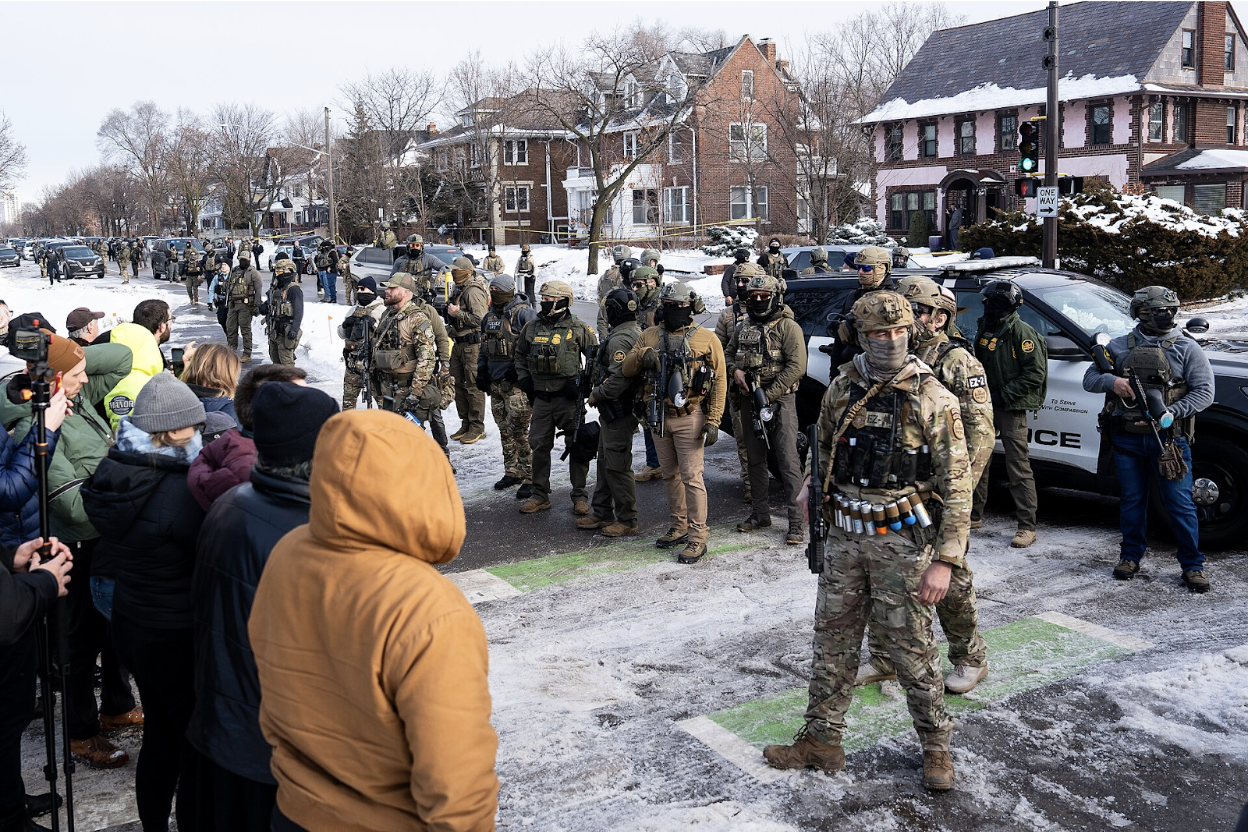
“ICE Agents in Minneapolis after Shooting” by Chad Davis under CC-A4.0
Edited by Allie Svetitz and Owen Andrews
In the past few months, the lives of Minneapolis residents have drastically changed. ICE and Border Control’s ongoing immigration crackdowns have caused many families to lose their homes and businesses and inflicted intense trauma, either because of direct experience or bearing witness to them. However, the city has not watched in silence. Thousands of citizens have stepped up to help through organizations such as Unidos MN, which Richfield, MN resident David Snyder has played a large role in organizing. I was able to discuss Snyder’s experience in this process, what residents in Minneapolis and surrounding cities have done to help so far, the trauma that immigrants have faced, and how he envisions a better future for the state.
Snyder grew up in Minneapolis and has spent 30 years in nonprofit work. At Johns Hopkins University, where he attended graduate school, he participated in the first campus living wage campaign in the country. Now, he is based back in Minneapolis and is a housing-justice organizer and a board member of Unidos MN.
Following Trump’s 2016 election, Snyder described a growing sense of fear among immigrants in Minneapolis. “This fear has intensified within the last ten years,” Snyder claimed.
Snyder shared a personal example about a close family friend who is an immigrant and a principal for a local public school with a large Latino student population. After the 2016 election, she told Snyder that she was scared and felt isolated, but that when he reached out and spent time with her, it helped her feel less alone. He made it a plan to visit her monthly, encouraging people from his synagogue to come play bingo and loteria with the families of students at the school. These gatherings sprouted many different partnerships and collaborations within the community in the years that followed. However, over the last 10 years this largely immigrant community grew even more afraid and targeted. Now, Snyder communicates with the principal and other teachers from the school on Signal channels, which allow those targeted by ICE to communicate with those that can help. These channels are essential at this time, as ICE agents are waiting outside schools to detain students and parents.
“It has been a really awful benchmark of how the community has been targeted, fear is now off the charts,” Snyder said.
Currently, Snyder is working with the Unidos board and the local Indivisible chapter to respond to the challenges and advocate for the immigrants in his community. Unidos MN is a grassroots organization that works with Minnesota's working families to advocate for social, racial, and economic justice. In November of 2025, Unidos launched the Monarca project, which trained thousands of observers to be ready to record and observe any interactions with ICE. Observers then report what they see to the board, which provides information to their legal team. If the ICE agent is lying about who they are or being excessively violent, this evidence can help in legal cases. The local Indivisible chapter, which was developed after the 2016 election, is a grassroots volunteer-led political organization. Snyder brought Unidos and the Indivisible chapter together, training over 1,000 people to be responders to ICE.
“We knew something bad was happening, and we needed to be prepared,” Snyder said.
Since the recent ICE events in Minneapolis, Snyder said there has been a huge growth in the people willing to volunteer with Unidos and other nonprofit organizations. He described the volunteers as “willing to do tremendous things to put themselves at risks which are unimaginable.”
These organizations have done more than just develop Signal channel groups. In their community, thousands of people have lost income, are afraid to leave home and go to work, or have had a family member abducted by ICE. To help with these issues, Snyder worked with his organizations to send extra groceries home with kids from school, pick up children from school, and deliver over 500 boxes of groceries directly to people’s homes. However, as Snyder pointed out, it is important that the immigrants they are working with have a powerful voice in how they are being supported.
“They know what's best, they know their community best,” Snyder said.
Furthermore, Snyder has been working with tenant leaders in apartment buildings where there is a majority of immigrants. The tenant leaders make handwritten lists of the families in their apartment, how many kids, what they need, and their phone number. Sometimes aid goes far beyond just providing food or money. In one case, five pregnant women living in an apartment building couldn’t go to the hospital because of ICE's presence in the area. The community worked to get in touch with the hospital so specific labor and delivery nurses could come and provide help to the women, essentially creating a safe birthing center at home.
Snyder spoke about the difficulty of building trust when working with immigrant communities. He did not have a hard time with this, as his past work with the Latino communities has allowed him to build connections and relationships. However, he explains that others he worked with did face some difficulty in building trust with immigrant communities.
“New people become frustrated with immigrants who don't want to work with them,” Snyder explained. To get past this barrier, he said that the volunteers need to teach each other patiently, acknowledge that it will take time and accept that it won't always be easy to help in the ways you want to.
“It’s a struggle, but an important part of crafting the right movement for the moment,” Snyder explained.
Although the intensity of the immigration crackdown has decreased in recent weeks, ICE still remains highly present in the Minneapolis area.
“People want to go back to normality, but they don’t trust anyone,” Snyder said.
For example, Snyder was made aware of an instance where an ICE agent specifically targeted an immigrant who owned a tow-truck company. The agent pretended to have their car break down right in front of the immigrant's house, manipulating him into coming outside to help. When the immigrant came outside, the ICE agents abducted him.
Another major issue is how this crisis has negatively affected the economy of the Minneapolis-St. Paul metro area and the state as a whole. Many immigrant-owned businesses have closed, weakening the economy of the city at large. Not only this, but the trauma of the community is extreme. Sydner describes how people are terrified to leave their homes and are skipping school and deferring basic health care. Without going to work, they are burning through their savings.
“As an organizer, it has never been more clear that people who are so afraid don’t assert their rights, which is totally destructive of a democratic society,” Snyder said. “Now even more than before, our whole society is vulnerable.”
Looking forward to the next few years, Snyder explained that meaningful reparative work will require deep political change and cross-community, cross-cultural engagement. People can act now by organizing at grassroots levels, ensuring that the work is grounded in solidarity. This approach transforms short-term deeds into sustained, long-term reparative work to combat social oppression.
“We can see the oppression and need to do something about it. We need to listen to people who are most impacted; they need to lead this.”