
Can America’s Center Hold?
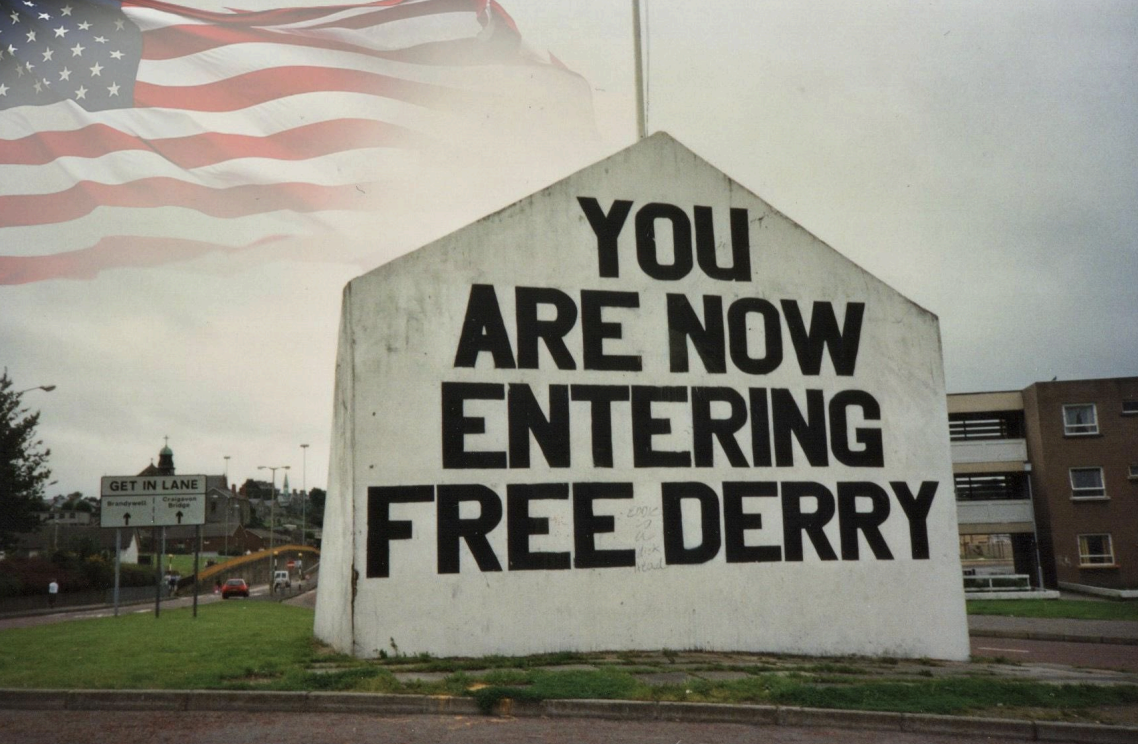
A photo of Free Derry Corner, Northern Ireland (edited)

The turmoil Irish poet WB Yeats expressed a century ago in “The Second Coming” seems almost prophetic. Yeats wrote the poem in the context of the religious and social turmoil in Ireland that eventually became the Troubles—a period of religiously inspired political violence that seized the nation in the latter part of the century. After a hundred years, though, the disillusionment and unease he expressed is ever-salient in a socially and politically-divided America migrating towards extremes. In examining the Irish Troubles from the 1960s to 1990s, parallels to the present-day US manifest as religious and political fervor that point towards an increasingly turbulent future.
After years of British rule, the Crown partitioned the Emerald Isle in 1921 between the majority Catholic Republic of Ireland and the majority Protestant Northern Ireland, which remained a constituent of the United Kingdom. The split was not amicable, and Catholics in Northern Ireland faced discrimination in jobs, housing, and politics over the next four decades, germinating by the late 1960s into a fully-fledged civil rights movement. Catholics gathered in demonstrations with varying degrees of belligerence in demand of greater equality, and Protestant groups like the fraternal Orange Order led counter-movements that brought the contention to the streets. In response to these riots and protests, the British government deployed troops with the stated aim of keeping the peace. However, this only escalated the situation as Catholic groups militarized their response, with the Irish Republican Army (IRA) and Ulster Defence Association (UDA) representing two groups focused on emphatic armed resistance to British rule. Incidence and outburst of violence proliferated, culminating in the 1972 massacre of 13 unarmed Catholic protestors by British forces in Derry, Northern Ireland, in what was dubbed “Bloody Sunday.”
Back in London, the Troubles became a “photogenic” cause célèbre that exacerbated existing tensions between Catholic and Protestant political factions, and invigorated governmental efforts to enact stricter, more restrictive measures against Irish Republican movements. In the growing fervor, the line defining what constituted a threat blurred, and soon the target of loyalist violence shifted from IRA or UDA combatants to simply any Catholic; so, too, did the drums and banners of the Orange Order come to represent all Protestants, not only those who marched under them. This simplification stripped people of agency and identity as they became their religion. Violence against people as mere symbols and stand-ins was more easily justified with the force perceived as a valid means of political expression.
Half a century later, a similar dynamic seemed to be at play in the religious imagery and symbols protestors boasted as they marched on the US Capitol on January 6th, 2021. Christian nationalism has seen an increase in prominence coinciding with the political rise of far-right figures such as President Trump. Scholars link this Christian nationalism’s expansion to greater support for the use of political violence. Through his appeal to the perceived victimhood of a unified white, Christian identity in America, Trump encouraged religious-based dichotomies similar to those that stoked violence in the Troubles. Defending the mob at the Capital, Republican Representative Mo Brooks framed the election and the riot’s contention of its results as the choice between an America “based on freedom and liberty” and one “based on godless dictatorial power.” This dichotomy of voters and Congress into a religious moral hierarchy vindicates violence taken against those in disagreement with Brooks’ coalition. Rhetoric like this strips individuals of nuance, instead ascribing predisposed ethical values based on such subjective categorization. With the growth of the Trump-backed Christian bloc, individuals increasingly morph into merely marionettes for the group they represent.
One faction morphs its opposition into an amorphous “other” and uses it as a scarecrow to scare away the caucus-breaking birds of complexity. The ability to assign people this value-carrying ecclesiastical label may explain the greater tolerance for political violence–such liberal and arbitrary categorization pushes us towards stratification reminiscent of last century across the pond. Coinciding with this hierarchical gap, a poll by the Public Religion Research Institute found that those aligning with Christian Nationalism were over twice as likely to be open to the use of political violence as Americans as a whole.
As with the Troubles, however, political violence is not confined to only one side of the American political aisle. The far right have imbued a rhetoric of divine intervention into President Trump’s attempted assassinations and highly politicized the killing of Evangelicalist frontman Charlie Kirk. Viewed as both leftist violence and anti-Christian violence, these exemplify the coupling of the far right coalition intrinsically with the Christian faith. The increasing emulsion of religion and political violence proves to be a growingly universal symptom. A University of Maryland study found that, in 2025, the government was the target of 35% of all violent events tracked — more than double the previous year’s rate, showing heightened politicization of violence. While Christian nationalists on the far-right represent a plurality of cases, the rate of violent acts rose in recent years among those described as left-wing, Islamist, and unaffiliated as well.
Filling in the next Troubles-trodden step on the path, President Trump justified his deployment of the national guard to oversee law enforcement agencies in Democrat-run cities like Portland and Chicago using this abstraction of an anti-Christian specter of violence. In further escalation, he even expressed interest in invoking the Insurrection Act to clamp down on protests in similar locales. The patterns of perceived victimization (whether justified or not) and the creation of an “other” group have led to a dehumanizing oversimplification of entire groups on both sides of the spectrum that threatens to, as with the Troubles, ignite a wave of violence and infirmity in our civil society. The attempts of the government at “anti-terrorism” seem directed at protestors and civilians within Democratic strongholds rather than those culpable of violent crime—signs of judgment by ideology, not action. As any Catholic became a stand-in for a bomb-wielding IRA officer and any Protestant a surrogate for an overreaching British policeman, so too do we see religiously-infused amorphisms of character lead to abrasive social schisms.
Fleeting negotiations and ceasefires persisted throughout the conflict in Ireland, but lasting peace was not realized until the turn of the century, when talks overseen by neutral international observers helped secure an accord approved by referendum in 1998. The Good Friday Agreement, brokered with US assistance, maintained a two-state solution and brought the fighting to a close, setting in motion the years of peace since. The lack of formalized factions in the United States has prevented much of the institutionalized discrimination that worsened the Troubles in Ireland, but so too does it pose a challenge in resolving the tension. There is no “anti-Christian” government responsible as a masthead for anti-Christian sentiment, nor is there such one for Christians. The joint bully pulpits of the political sphere along with social media have blurred faction lines but failed to soften their intensity. America’s closest parallel to the institutionalized religious split is its partisan division, whose nebulousness and lack of legal religious establishment renders the chance of active intervention slim. While the American Christians’ perception of victimhood is not vindicated by a history of prosecution as was the Catholics’ in Ireland, it remains no less salient to the dehumanizing spread of violence we have observed in American headlines over recent years.
Unlike the close of the Troubles, America’s solution may lie in the informal influences that originally began the conflict. The instant connection of social networking, which allowed collusion across conflicting factions, may prove to be a source of unity as anti-violent sentiment on all sides grows. However, only a vocal minority actually supports higher tolerance for political violence. The coming months of communication from and surrounding the White House will be salient in directing our course forward socially. But the speech and actions of one person, whoever that may be, no less define a whole group than did Bloody Sunday or the Brighton Hotel Bombing prescribe entire religions.