
A Safe Place to Disagree: What Happens When Students Debate Their Professors
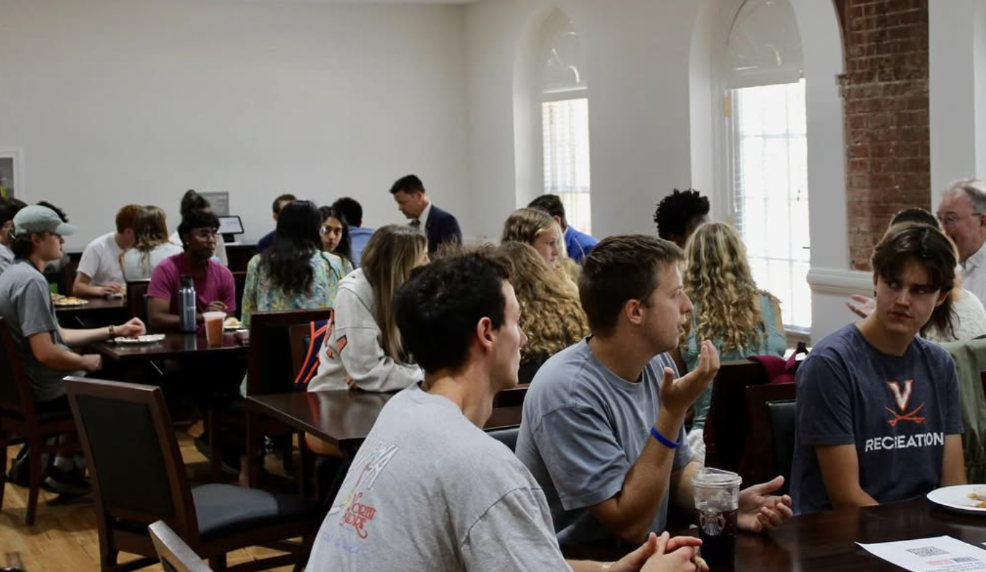
Photo Source: Think Again UVA Instagram
In light of Charlie Kirk’s death, tensions over speech and safety have surged across American university campuses. Some argue that political disagreement now carries unprecedented risk. Others insist that universities must double down on open inquiry rather than retreat from the controversy. Against that backdrop, the Think Again UVA event “Disagree with a Professor” offered something needed in times like these–a space that welcomes disagreement.
I arrived at 11:45am, fifteen minutes early, to the Rotunda Multipurpose rooms, where four professors were seated at the head of each table. Professor Mary Kate Cary, Director of Think Again UVA, opened the event with warmth and humor. In 2021, Professor Cary served on UVA’s Committee on Free Expression and Free Inquiry, which created the University’s current free speech policy guiding open, respectful debate. Previously a White House speechwriter for President George H.W. Bush and recipient of the 2024 Heterodox Academy Open Inquiry Leadership Award, she framed the afternoon as an experiment in civil disagreement.
Professors had their “hot takes” posted on a paper taped to their tables, inviting students to press and question their views — not as adversaries, but as interlocutors.
Over two hours, four UVA professors — Colin Bird, John Casteen, Sherri Moore, and Brad Wilcox — presented provocative theses on topics ranging from technology use in class to whether or not washing your hair is needed. Colin Bird, who is a staple in the politics department and the realm of political theory, was ready to challenge assumptions and defend his argument with sharp, philosophical counterpoints. John Casteen, an English professor who teaches ENWR, special topics courses, and serves as Principal of Brown College, brought a perspective grounded in his deep belief in the UVA community that shaped the values behind his arguments. Sherri Moore, who teaches the iconic Commercial Law courses at the McIntire School of Commerce, approached debate with practical and real-world insight. Brad Wilcox, a sociology professor who teaches Sociology of the Family, is known for tackling subjects that can seem controversial on CourseForum but that he approaches with conviction and data-driven analysis. He firmly stands by his views on the importance of marriage and family, which he explores in his book Get Married: Why Americans Must Defy the Elites, Forge Strong Families, and Save Civilization.
Together, they created a lively discussion that challenged students to think beyond a simple “I agree” or “I disagree.” The following section recounts each prompt and the student reactions they sparked.
Professor Sherri Moore (McIntire School of Commerce)
Computers and cell phones should be banned from every UVA course.
Congress needs to regulate social media.
NIL (Name, Image, Likeness) corrupts the spirit of college athletics by prioritizing money and endorsements over education, teamwork, and fair competition.
Students were quick to challenge Moore’s call for banning technology. Some argued that laptops and phones are essential for accessibility, note-taking, and emergency purposes. Others sympathized with her frustration, acknowledging that screens cause disruption to discussions and to students’ attention.
Professor Colin Bird (Politics)
Equality is overrated. Whether individuals’ wealth, opportunities, and power are relatively “equal” is of no importance whatsoever. What really matters is that everyone has enough to live well; regardless of any other disparities of wealth, opportunity, and power.
No state has the right to deny any human being access to its territory and economic opportunities available within it, except in two very narrow cases: (1) when a receiving state has evidence, beyond a reasonable doubt, that an individual migrant intends harm to its citizens; and (2) when a receiving state has a genuine and serious overpopulation problem. Apart from these marginal exceptions, borders should be completely open.
Washing one’s hair is, under normal circumstances, an unnecessary waste of time. Using conditioner to undo the damage done by shampoo is even more irrational.
Students found Bird’s “hair” prompt unexpected. What first sounded like a quick, humorous aside turned into a light-hearted discussion. Most, if not all, students disagreed, citing practical reasons like having long hair, oily roots, or social expectations around hygiene. Bird, however, stood his ground, insisting that our hair would adjust to the oils we produce over time if people simply stopped over-washing it.
Professor John Casteen (English)
The University should install traffic gates at the Chapel, in front of Gilmer Hall, and at the Emmet Street intersection, closing Grounds to all motor vehicles — except faculty residents, UTS Buses, EMS, UPD, and FM — during weekdays from 8:00am until 7:00pm.
Residential colleges and other living-learning communities provide a value to students and faculty that integrates their learning with their social development. The University should convert its fraternity and sorority houses for this purpose.
If given the choice between voting for one candidate who’s imperfect or another who’s a catastrophe waiting to happen, the utilitarian choice — voting for the imperfect candidate — is preferable to refusing to vote, which is the idealistic choice. The meaning of a ballot lies in its outcomes, not its statement about the voter.
Casteen’s table inspired thoughtful debate about campus life and civic responsibility. Particularly, the residential colleges prompt sparked the most engaged discussion. Casteen, who serves as Director of Studies for Brown College, drew from his own experience living there to describe how residential learning communities blend academic life with social connection. He explained how the model encourages students and faculty to share meals, host discussions, and continue classroom debates in informal settings — fostering a sense of belonging that extends beyond academics. Students were divided; some supported expanding this approach to fraternity and sorority houses as a way to promote inclusion and civic engagement, while others defended the independence and traditions of Greek life as vital parts of UVA culture.
Professor Brad Wilcox (Sociology)
The best path for women to a meaningful and happy life is marriage and motherhood.
The best predictor of “economic mobility” for poor children, at the community level, is family structure.
When it comes to sex, practice doesn’t make perfect — men and women with fewer sex partners have happier and more stable marriages.
Wilcox’s table drew steady attention throughout the afternoon, as his prompts centered on themes he often explores in his Sociology of the Family course. His statements touched on the intersections of gender, culture, and social mobility — topics that tend to provoke both intellectual and emotional reactions in a college setting.
Particularly for the third prompt, students immediately pushed back, arguing that happiness in marriage depends more on communication and compatibility than on the number of past partners. Some questioned how such a claim could account for changing social norms and generational attitudes toward relationships, suggesting that it reflected older or more traditional values.
Takeaways:
Across all four tables, students appeared eager to challenge but not attack. The atmosphere was proactive, yet civil, embodying Think Again UVA’s goal of “productive disagreement.” To make the session interactive, professors asked students which prompt they wanted to start with, sharing their brief thoughts, and then opening the floor for discussion. This approach made the experience feel like a small forum of open exchange rather than a lecture, allowing students to become more comfortable voicing their critiques and curiosities.
A second-year student in the College captured the spirit of the event as:
“I felt that it was a great space for close discussions with professors. I had a lot of fun being in small groups and getting to talk about different subjects with the professors and hearing their insight, as well as other classmates. I thought others also enjoyed it because there was a good exchange of ideas.”
Some moments stood out as particularly surprising. Professor BIrd’s argument about the ritual of washing one’s air sparked laughter and strong disagreement, as many students pushed back his claim. Even after suggesting that hair and oil would adapt over time, people were still unconvinced. Professor Wilcox’s claim that marriage and motherhood is “the best path for women to a meaningful and happy life” drew perhaps the most charged reactions, with students challenging his assumptions about gender roles and the diversity of family structure. Professor Casteen’s suggestion that fraternities and sororities should operate more like academic residential communities prompted debate, with some students agreeing that it could strengthen UVA’s intellectual culture while others felt it would erase the social value those organizations provide. Meanwhile, Professor Moore’s firm stance that cell phones should be banned in classrooms won surprising support, with many students admitting they would be more focused without the distraction.
Yet instead of shutting down debate, these moments energized the room. Each claim, however provocative, pushed participants to think more critically and even reconsider their own assumptions. In several instances, students conceded to a professor’s reasoning, while professors, too, acknowledged when student counterarguments revealed new perspectives.
The discussions proved that disagreement, when grounded in respect and curiosity, can deepen understanding rather than divide. Even the most controversial topics — from technology bans to family life — were approached with humor, patience, and mutual engagement. In a time when campus discourse nationwide often feels polarized, Think Again’s “Disagree with a Professor” served as a reminder of what makes UVA distinct: a commitment to intellectual openness, civil dialogue, and the courage to engage across differences.