
Edited by Juliette Calderon, Aliza Susatijo, Amelia Cantwell, and Owen Andrews
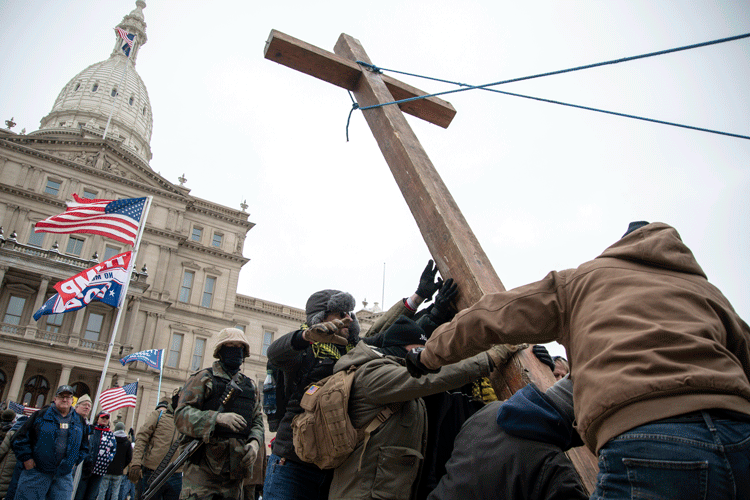
On May 17th, President Trump referred to his prayer event at the National Mall as an opportunity to “rededicate America as one nation under God,” demonstrating the extent to which Christian nationalism has become a force in current politics, influencing how politicians mobilize citizens. While Christianity’s original teachings are rooted in empathy, compassion, and caring for the poor, the Republican brand of Christian nationalism instead emphasizes American exceptionalism. In the 2024 election, eight in ten White Evangelical Christian voters supported President Trump. There is no doubt that Christian nationalism has become a growing trend among many politicians, proving successful in attracting voters and signaling a shift from traditional religious values. Christian nationalism in the U.S. began with European colonizers and the Puritans who merged Christianity with governance. After the late 20th century, the association between conservatism and Christian nationalism has greatly influenced the Republican Party. Given the recent development of Christianity transforming into a political tool for politicians, it’s critical to analyze how this movement has changed our political climate and the greater implications of religious radicalization. Most importantly, this radicalization of religion and the dangers it imposes must be recognized to preserve American religious freedom.
Christian nationalism centers on the belief that the U.S. was founded as and should be governed as a Christian nation. It supports a vision of the U.S. as sacred, rooted in Christian values that need to be preserved. There are many subgroups within Christian nationalism, including the New Apostolic Reformation, who believe in revolutionizing the American government and reviving the U.S. as a “good,” Christian nation. The New Apostolic Reformation has direct connections to the Trump administration, as members were present at the White House just a couple of days before the January 6th insurrection and maintain strong relations with the Speaker of the House, Mike Johnson. White Evangelical Christians, in particular, have played a crucial role in Trump’s platform. In April 2026, Trump and top Republicans dedicated a week to celebrating America’s upcoming 250th birthday with a marathon reading of the Bible. This week is intended to display how the U.S. was founded on Christian values and how the Bible is "indelibly woven” into the American identity. This is one piece of Trump’s larger agenda of promoting MAGA Christian nationalism and undermining a cornerstone of American democracy—religious freedom. These constitute threats to America’s foundational doctrine of separating church and state.
With Christian worship becoming characteristic of Trump’s second administration, Secretary of Defense Pete Hegseth has especially embodied these values. Hegseth has justified U.S. military action in Iran with an American “divine right” and “Christian moral duty.” In his efforts to establish government sponsorship of religion, Trump has warned Americans of a “war on Christianity” spreading around the world. In November of 2025, Trump threatened to use military action in Nigeria after Senator Ted Cruz called their long-standing conflict between Muslims and Christians “Christian mass murder.” In February of 2025, Trump also signed an executive order to create the White House Faith Office, furthering his agenda of cracking down on “anti-Christian bias” and forming a task force led by former Attorney General Pam Bondi to investigate threats to Christians. These actions, coupled with immigration raids in churches and limiting religious diversity, undercut religious freedom that is unprecedented in American history. The administration has broadened the criteria of what constitutes domestic terrorism to include anti-Christianity and anti-Americanism. This is not only an infringement on religious expression, but also on freedom of speech.
Recent polls have also shown that young men find religion more important than ever before. Compared to 28 percent in 2023, 42 percent of young men in 2025 say that religion is “very important” to them. The emergence of Christian nationalism, however, has deeper implications. Trump has strengthened the relationship between Christianity, white replacement theory, and conspiracy theories/groups—all supported by a third of the American electorate. These ideologies define “real” Americans as white Christians or “native-born” Americans, reinforcing the notion that demographic change that comes with increased immigration threatens the American identity. White replacement theory, therefore, believes that immigrants are replacing “real” Americans. Additionally, it’s researched that 6 percent of whites and 11.5 percent of white evangelicals would justify violence in order to preserve the “Americanness” and Christian values of the U.S. This reveals the extreme lengths some Christian nationalists would go to protect their values and what they view as “best” for the nation. The radicalization of religion has not only turned into a political tool but also a tool of violence when they feel their interests are violated.
These findings are shocking and provocative: Religion has seen a clear departure from its original intent and has become a political tool used by the Republican Party. It’s taken an extremely radical turn with conservatives and far-right groups, in accordance with the preservation of the “white race” and reinforcement of conspiracy theories that threaten America’s political stability. It’s an issue not to be glossed over but one to be taken with caution. Christian nationalism is evolving rapidly, which endangers American culture, separation of church and state, and individual rights to peaceful expression without fears of inciting violence. Combating this radicalization would require persistent efforts in grassroots movements, promoting traditional Christian values, and calling out constitutional violations.